

Article: Why Most Knee Pads Fail Figure Skaters, and What I Learned Testing All of Them
Why Most Knee Pads Fail Figure Skaters, and What I Learned Testing All of Them
I've spent time on almost every side of this sport. Competition skating, show skating, choreography, coaching, all of it, at different points. What's stayed constant through every part of it is what I love most: exploring what the ice actually lets you do with movement. I have a dance background, and it always pulled me toward one question: Can skaters use the ice the way dancers use a floor?
That question is where this whole thing actually started, years before Edge existed as an idea, let alone a product.
The Injury That Started All of This
At one point I had to change how I trained. Skating consistently, the way real jump progress needs, wasn't something I could do anymore since I was only able to skate maybe every three or fours months. I got frustrated with not being able to skate the way I used to, so I started looking for other ways to use the ice.
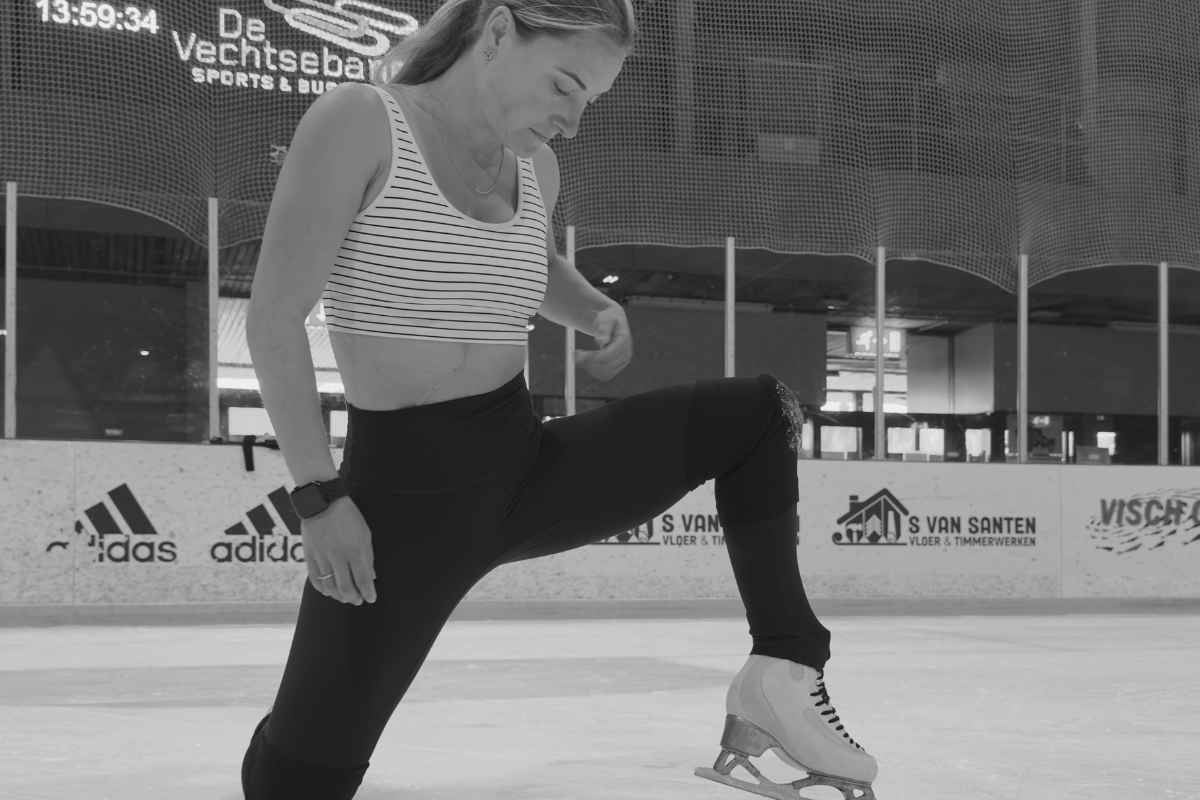
That's when knee slides became something I genuinely loved. Exploring the ice as its own surface, the way a dancer explores a floor. I did them often, and I bruised often, and for a while I just accepted that as the cost of doing something I liked. I could really only do it safely a few times, or on clean ice.
Then one day I was sliding on ice that had just been resurfaced. I was the only one on it. My knee caught the most microscopic bump, one I could never find afterward (trust me I tried), but I could absolutely feel it. The pain was so bad that I genuinely thought I'd split my kneecap in half. Luckily I didn't but it did take weeks to recover.
That was the moment I decided I would never do a knee slide unprotected again.
Nothing Out There Actually Worked
So I went looking. Dance pads, volleyball pads, generic foam knee pads, all of it. Every single one failed me in some way. Too thick. Slid down mid session. Didn't protect the actual spot my knee was gliding on. Restricted movement I needed for a deep knee bend. Looked bulky and not aesthetically pleasing. Some combination of all of it, every time.
Then, a couple of years ago, I was at a dancing workshop and was given knee pads made with silicone. I'd genuinely never known knee pads like that existed at the time. I started wearing them for knee slides, and for the first time, something actually worked. Slim, flexible and protected the right spot.
Coming Back and Hearing the Same Complaints Everywhere
After about two years away from skating, I came back to do some choreography again, and the sport had changed. Almost every skater's program now had some form of a knee slide in it.
But I kept hearing the same handful of sentences, over and over, from different skaters. My knees hurt, I can't do it again today. I forgot my knee guards. They keep sliding down. I don't wear them, they're not comfortable. All logical, all valid reasons, and all of them meant skaters were either in pain or going without protection entirely.
I'd already made a rule for my own students: no knee slides without protection, full stop, because of what I'd been through myself. One skater I was choreographing a program for wanted a knee slide in it, so I gave her the pair I'd been wearing. She told me they were super comfortable.
That's the moment it actually clicked. Everyone was complaining. Nobody was building anything for it.
Boots and Blades Have Decades Behind Them. Nothing Else Does.
Once I started actually looking into it, researching materials, understanding the real difference between foam and silicone, I realized something bigger than just knee pads. There's no brand, and nobody in figure skating specifically, looking at this gap. Boots and blade companies have decades of engineering and knowledge behind them. Nobody is doing that same work for what a skater wears everywhere else on their body, the gear that supports and protects them through everything training actually asks of them now, at any level, recreational or professional. To me, anyone who steps on the ice is a skater. I don't separate that.
Coaching is what I keep coming back to, because I love it, and this felt like the same instinct in a different shape: giving skaters the tools to actually explore their own skating, safely. About a year ago, that turned into an actual decision. I was going to build knee guards properly, find a manufacturer, and figure out how to make this real.
What Actually Changed From What I'd Been Wearing
I want to be honest about this part, because it matters. The silicone knee pads I'd found were good, but they only came in two sizes, and if Edge was going to exist, I wanted every skater to be supported, regardless of their level, age, size, or background. Most existing skating wear is built with young skaters in mind.
I tested four different samples from manufacturers working with silicone, and chose the one with the best actual fit. From there, it was about five months, September through January, testing samples and improving them. The knitwear needed to be tighter, since the original fabric was too loose for what skating actually demands. We built a proper size range. We worked on durability specifically for sustained, repeated sessions, not just one wear. And we put real quality control in place on every unit, which matters more than it sounds like it should. Edge Gel Knee Guards launched with that first product in February 2026.
Where This Goes Next
None of this stops at knee guards. Skaters are sliding on elbows too, which means elbow sleeves are a real, obvious next step. Competition brings its own version of the same problem, and if you've watched the recent Olympics closely, the number of bloody knees and torn tights makes the case on its own. A knee guard slim enough to sit under tights and stay essentially invisible isn't a nice to have anymore, it's close to a necessity.
Then there's everything involved in floor work beyond the knee. Most skaters doing hand to ice contact are wearing gloves that were never built for it, cheap, not water resistant, full of holes fast. I know this one personally. Years of that kind of repeated cold exposure left me with chilblains, small, itchy, swollen patches on my fingers that some winters still show up years later at the first real cold snap, even now. I also know other skaters who've developed Raynaud's phenomenon, a related but separate condition, from the same kind of repeated cold exposure. Skaters don't tend to think about this, because they're not standing around outside, they're training. But the body doesn't know the difference.
That's the real direction Edge is heading. Developing a new fabric for leggings and tights that's genuinely water resistant, that keeps cold out without trapping heat in, since skaters sweat in cold rinks whether they notice it or not. Materials that can actually hold up to the specific friction of sliding on ice, not just fabric borrowed from yoga or dance that was never built for a blade or for what ice does to it. And an honest, ongoing look at whether foam, silicone, or some combination of both is the right answer for a given kind of protection, rather than assuming one material solves everything.
Your body is your temple, and figure skating hasn't always treated it that way. Pain and bruising were just accepted as part of the process for a long time, mine included. I don't think that has to be true anymore, and building the gear that makes that possible is the actual point of all of this.
If you want to see where it started, this is the pair that got skaters talking in the first place.